Saturday, November 29, 2014

ABAN and Children of the Light

Sorry for the blog silence, I have much to update everyone on! I will start with my service-learning volunteer experiences at A Ban Against Neglect (ABAN) and Children of the Light after-school program. 

While at ABAN we, two other Calvin students and myself, worked with about twenty women and their children. The program is designed to empower these women, most of them school dropouts, to obtain employment and learn business skills so that they will be respected in their various communities and also provide for their families. There is a special emphasis given to being environmentally friendly especially with the water sachets that many people buy. Seamstresses that are employed at ABAN use these sachets to make various products such as bags and purses. These women were eager to learn and they were a joy to be around! We were able to help organize a their library, create a community event proposal, help out in the daycare, and also teach a few classes. Reflecting on my experience there, words cannot truly describe and express how wonderful these women and the staff at ABAN are!Learn more about ABAN at www.aban.org

Pictured below: The ABAN women working on a recycling project, the library we organized, daily classroom set-up, and two of the kids playing together.


At Children of the Light after school program we worked with teachers and helped supervise the many kids that come every Tuesday and Thursday. They are currently readying themselves for their annual Christmas program, so they were coloring stars and Christmas trees. We also helped tutor kids in math and spelling as those are the areas that the teachers identified as needing the most work. Despite not having incredibly fun content to work on, these kids were very enthusiastic and upbeat which was impressive and slightly overwhelming for me (in a good way)! 

Pictured below: the kids working on Christmas decorations.


Friday, October 17, 2014

Things you (might) do in Ghana: Volume III- Odwira Festival

1. Presenting gifts before the chief- schnapps, food, rams, and money. The girls would dance in the procession as part of the celebration for the ancestors. 


2. On Thursday, we witnessed a procession to feed the ancestors. People from each of the major houses in Akropong were chosen by a spiritual leaders to carry food and drink to the sacred tree. These people are said to be taken over by the spirits so it is necessary to have people there to withhold them if they start going the wrong direction or stop moving. These people will be very fickle if there are problems in the family. When these people stop moving altogether, other family members will pour libation on their feet with schnapps to appease the spirit that is said to reside in them. White is the color of purification- the goal of the festival. 


Drummers announce the procession.

3. Drum crews line the side of the streets. Their accompanying dancers would catch passersby and dance with them. If you are chosen by the dancer, you would also offer up small cash to them. 


4. Durbar grounds. All processions on Friday led to these grounds where there were speeches given by community leaders and even the President of the Republic of Ghana himself!


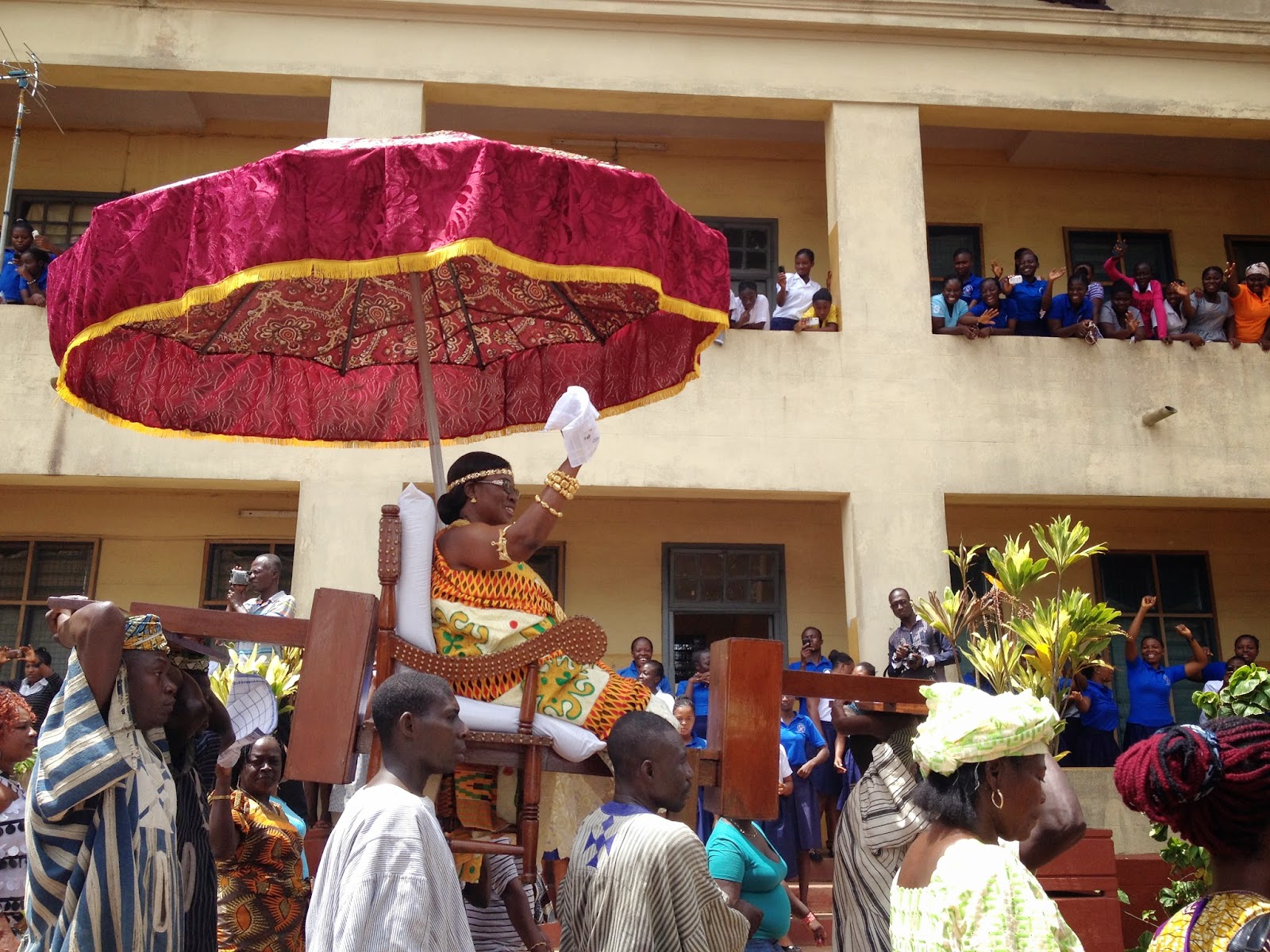
5. Local chiefs and queen mothers processed into the Durbar grounds under umbrellas and carried on chairs and in palanquins. Each chief and queen mother was elaborately dressed and had many supporters surrounding them.


6. Among the diplomats at the Durbar, we saw Former President Jerry John Rawlings. For more information go to: http://www.presidentrawlings.com/pgs/hmp.php

Rawlings and his wife at the Durbar
7. While waiting for the Durbar, I made a friend- Emmanuella. This little 5 year old sat with me while we waited for the procession to end and the speeches to begin! 


Monday, October 6, 2014

Things you (might) do in Ghana: Volume II

Stories and experiences in Northern Ghana:

1. The gargantuan Kintampo Falls. This was our first stop on our way to the North. Kintampo Falls is a series of 3 different sets of falls and pictured below is the third and biggest falls. When you stand, or more likely sit, under the falls you will get pounded by torrents of water. Nonetheless, the waters are perfect for a hot day and they are also a perfect excuse for getting off the bus!


2. Participating in a beautiful celebration of the Northern Presbyterian Church in Tamale. We were able to march in a mile long procession with the congregation. It wasn't your normal procession though, it consisted of dancing, singing, and playing instruments. It was a jubilant celebration of God's gifts to this particular congregation.


3. While in Bolgatanga, we visited TAWODEP (Talensi Area Women's Development Project). We were able to help produce shea butter and we learned about the process to make it from start to finish. The shea nuts are pounded and mixed with water until it is a smooth consistency. The oil is then boiled off which takes away the brown color (seen below left) and the product is the butter (seen below right)


We also participated in making pito, a traditional Ghanaian alcoholic beverage. This is made from millet and maize that is ground on a stone pestle and mortar. They had both fermented and un-fermented pito available for us to try from the traditional means- a calabash instead of a cup!


TAWODEP also works with a group of women who create beautiful baskets. Most of their baskets had been sent to market the previous day, but they were all hard at work weaving new baskets for the next market day. The baskets pictured below are nearly completed, and I was able to purchase one directly from the woman who wove it.


4. Bolgatanga is about an hour away from the Burkina Faso border, and we were already planning to visit Paga, Ghana which is right on the border so why not try to cross the border even if only for a few minutes! Ghana's immigration officials allowed us to briefly cross the border into Burkina Faso, so we are able to add one more country to our lists!


5. Paga is famous for its sacred crocodiles due to the amount of these humongous beasts that reside in and around Paga. While there, it would be a shame to not try and see at least one of these creatures. There are even guides that will help you get especially close to these crocs, all you have to do is buy a white chicken to feed to it (also for a distraction method when you are behind it). People are able to touch the crocodile's back, and some people even pick up its tail if they are brave. Needless to say, I was terrified!


6. These forms of transportation.

Notice the luggage barely staying in the trotro
(vans that seat around 20 people) on the left.

Goats and sheep on the roof.

We actually fit around ten of us in this
small motor bike!
7. We were able to go to a beautiful Gonja fiddle performance and attempt to participate in the dance that is performed along with the fiddle playing. The instrument itself is a one-string fiddle that is passed down through the males of a family. Each fiddle player makes his own instrument and teaches any boys in his family how to play the fiddle. The dancers usually wear a traditional smock (not pictured here) which defines their movements as it swirls around their bodies.


8. The Larabanga Mosque. The architectural style is Sudanese, and this is the only mosque styled in this way in Ghana. Each side has a different entrance- one for women, one for men, one for the muezzin, and one for the imam. The Baobab tree seen below only strengthens the foundation of the mosque. It is said that everyone in Larabanga is Muslim and will attend Friday prayers at this mosque. However, it can only hold one hundred of the four thousand civilians in Larabanga.

Women's entrance in the back

Men's entrance on the right side

9. Mole National Park. Even though we didn't see any elephants, we were able to see a lot of wildlife at the park. We saw warthogs, baboons, patas monkeys, mongoose, crocodile, water buck, and bush buck. The heavy rains that the park has received lately is actually keeping the animals away because their are other water sources farther north that much of the wildlife is taking advantage of instead of the water hole in Mole National Park that is the most consistent source of water during the dry season.


Thursday, September 25, 2014

Things you (might) do in Ghana: Volume I

Here's my next blog post- you're welcome, Mom and Dad!

1. Drink coconut water straight from the source, careful we do indeed wield machetes. One of our hosts for the week walked (climbed) up the tree to retrieve these fresh coconuts for us.


2. Visit Aburi Botanical Gardens. The beautiful drive in the gardens was on a palm-lined road. We saw a variety of plants including allspice (pictured below), coniferous trees brought to the gardens by European officials, shea nut trees, cocoa trees, coffee, curry, hibiscus and many other beautiful flowers.


3. Tour a cocoa farm to learn how they harvest the fruit, ferment the beans, and also dry the beans to be ready for sale.

Underneath the palm leaves, cocoa beans are fermenting.

Freshly opened cocoa fruit. The beans are sweet and tart.

 4. Holding children whose mothers trustingly let strangers carry these precious kids around the village. Older children often followed us around as well, and many of them held our hands. It would not be odd to see one of us surrounded by children attempting to hold our hands or play with our hair or sit on our laps.


5. Making aboloo (similar to cornbread) and placing them in leaves to be cooked in a traditional clay oven.


6. Walking through the forest in a rainstorm- of course the obvious thing to do would be to cut palm leaves to use as umbrellas!


7. Crab hunting. Basically, you stick your hand shoulder deep into the mud and attempt to grab the crab at the bottom. It really went against common sense to stick one's hand in the mud and expect to get a crab (where are the snakes and other unwelcome critters?), but luckily we all got a crab. There are even a few pinch marks to prove it! (Not pictured- our snail hunting festivities.)


8. The fruits of our labor- snail kabobs and boiled crab. The kabobs were surprisingly good with red pepper seasoning and onions and green peppers. However, those snails were probably the chewiest thing I have ever eaten. As for the crabs, most of the shell is supposed to be eaten except for the upper section of the crab. It was very similar to eating scorpion in China, but I managed to eat some of the legs, one of the claws, and some of the brain. (Maybe it will make me smarter??? :) ) Anyway, I am happy to be having so many new experiences! 


The finished product- boiled crab, roasted
snail kabobs, and orange-pineapple juice.